

The WF has awarded a 2026 Special Grant to Housing Resources Inc. in support of expanded homeownership services
for women and families in greater Milwaukee. Click here to learn more.

Women face real challenges. We take action to address them.
For 40 years the Women’s Fund of Greater Milwaukee has turned belief into impact.
We invest in what moves the needle: strong organizations, innovative programs, leadership development, research, policy advocacy, and community-driven solutions. Our work is rooted in one truth… when women thrive, families and communities do too.
Through collective giving, strategic grants, scholarships, and programs, we protect rights, remove barriers, and drive systemic change. And we don’t do it alone. This work belongs to all of us. We invite you to be part of it.
IS YOUR ORGANIZATION DOING SOCIAL CHANGE WORK FOR WOMEN IN GREATER MILWAUKEE?
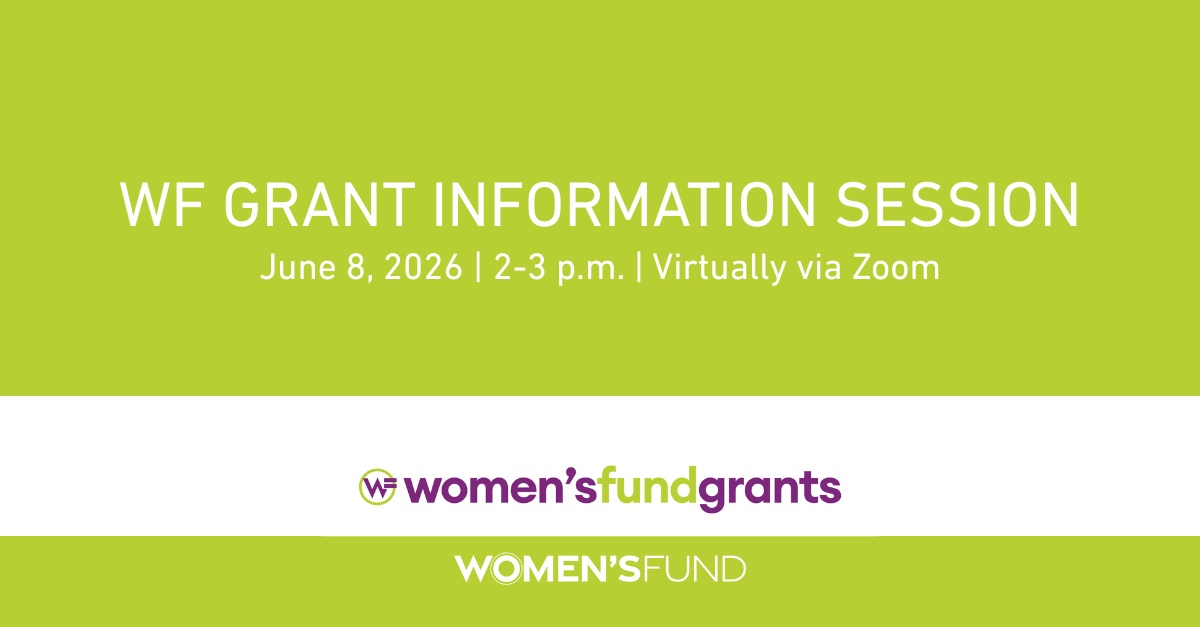
The Women’s Fund awards grants of $5,000–$25,000 to nonprofits advancing equity for women and girls in our community. If that sounds like your work, the first step is our Grant Information Session… a free, virtual briefing on June 8 from 2–3 p.m. Registration is required. Space is limited.

SAVE THE DATE FOR WF CIVIC BREAK ON JUNE 18
Mark your calendar. Our next WF Civic Break is set for June 18 from 12:30–1 p.m. Civic Breaks are free, 30-minute virtual briefings designed to cut through the noise on a timely topic. This month’s topic details coming soon.
Free to attend. Registration required.
THE REALITY FOR WOMEN IN GREATER MILWAUKEE
Women in our region are educated and engaged yet inequities in safety, housing, health, and economic stability continue to limit opportunity.
Women in greater Milwaukee are highly educated:
-
39% hold a bachelor’s degree or higher (compared to 34% statewide).
-
Yet 7% of women still lack a high school diploma which is slightly above the state average.
Education opens doors, but it does not guarantee equity.
Despite educational gains, a gender pay gap persists locally.
- Women earn about 74 cents for every dollar earned by men in greater Milwaukee, which is wider than the state gap.
-
Significant racial disparities: White and Asian women are more likely to earn ≥ $55,000 while
only 25-30% of Black or Hispanic women reach that threshold. -
Poverty rates differ sharply by race:
-
32% of Black women
-
21% of Hispanic women
-
7% of White women
-
Access to care does not always mean healthy outcomes, and safety is far from guaranteed.
- Health insurance coverage is high among women in Greater Milwaukee, with about 5%
uninsured versus 7% of men; however, coverage gaps are greater among younger
women (19-34 years.) - Maternal health issues are stark: preterm birth rates in Milwaukee County (11.6%) and
City of Milwaukee (13%) exceed state averages. - Women of color face disproportionately high risks of violence; Black women and other
women of color in the city are disproportionately likely to be killed by someone they
know.
Stable housing remains one of the greatest barriers to long-term security for women and families.
-
Homeownership by women is lower locally (60%) compared to Wisconsin generally
(68%). Particularly large disparities by race regarding home ownership:-
only 27% of Black households own homes
-
44% of Hispanic/Latino households
-
70% of white households
-
- Rent burden is significant: many renters who are women pay more than 30% of income
for housing. Milwaukee County is among the counties with the highest rates of cost-
burdened renter households. -
Eviction rates for women are elevated: about 5.9 evictions per 100 renter households in
Milwaukee County vs 2.8 statewide. -
Median rent (including utilities/fuels) for women in greater Milwaukee is $1,088/month vs
state median $992.
WHY PHILANTHROPY MATTERS NOW MORE THAN EVER
WOMEN ARE POISED TO SHAPE THE LARGEST TRANSFER OF WEALTH IN HISTORY, TURNING RESOURCES INTO LASTING CHANGE. WHEN WOMEN GIVE, ESPECIALLY TOGETHER, THEY INVEST IN EQUITY, OPPORTUNITY, AND THE WELL-BEING OF FAMILIES AND COMMUNITIES. BY DIRECTING THEIR WEALTH WITH PURPOSE, WOMEN CAN TRANSFORM PERSONAL LEGACY INTO A STRONGER, MORE VIBRANT GREATER MILWAUKEE FOR GENERATIONS TO COME.
- More than $557 billion is given annually in the USA.
- There is more than $326 billion in donor advised funds (DAFs) in the USA and more
than $1 billion in greater Milwaukee. - Just 2% of all philanthropic dollars are in direct support of women and girls.
- Women’s Funds and foundations, move money nine months faster than traditional granting entities.
- We are in the midst of the largest transfer of wealth in history, and women are poised to hold extraordinary influence over how that wealth is used. Through intentional giving, women can turn personal legacy into lasting community change.
- When women direct resources, they invest differently… prioritizing equity, opportunity, and long-term well-being for families and communities. The choices women make today will shape greater Milwaukee for generations.
- Despite increasing control of wealth, persistent gender and racial wealth gaps limit who has access to influence. Strategic philanthropy is one powerful way to create greater equity and build shared prosperity.
- Collective giving allows women to move wealth beyond individual impact; thereby, amplifying voices, addressing the root causes and advancing policy change.
- For many women, wealth is not simply something to pass on. It is a tool to express values, strengthen democracy, and invest in a future where everyone can thrive.
why our work matters
Just 2%… The latest study from the Women’s Philanthropy Institute at IUPUI indicates that only 1.9% of all charitable giving supports organizations for women and girls.


JOIN THE MOVEMENT:
Be an outlaw for change, and let’s weave
possibilities into reality together.
recent media

WUWM’s Lake Effect Breaks Down the Women’s Well-Being Index
WUWM’s Lake Effect recently featured findings from our Wisconsin Women’s Well-Being Index,...
BizTimes Photo Gallery: The Science of Happiness
A joyful evening, captured in full color. Earlier this month, the Women’s Fund of Greater...
Radio Milwaukee Spotlights “Cult Queen”
Radio Milwaukee recently spotlighted Cult Queen: A Rachel Talalay Retrospective, the October...
Civic Media’s Don Rosen Talks Cult Queen Retrospective
Dr. Cara Ogburn, artistic director at Milwaukee Film, joined The Don Rosen Show on Civic Media to...
Featured in Milwaukee Business Journal’s Partners in Philanthropy
We’re honored to be recognized in the Milwaukee Business Journal’s Partners in Philanthropy...
Notable Alumni: Sandy Cunningham
We’re thrilled to celebrate Sandy Cunningham, honored as a "Notable Alumni" by BizTimes. Sandy’s...


As we honor the remarkable achievements and resilience of women worldwide, we’re reminded of the profound impact that local women have within their communities. As the Women’s Fund of Greater Milwaukee, we stand in solidarity with women everywhere, advocating for their voices to be heard, their talents to be recognized, and their potential to be fully realized.
The WomenStrong organization recently wrote an essay that included: “when local women step up, speak up, and are actually heard, their advice and choices usually turn out to be the best available for the communities they serve.” This sentiment resonates deeply with our mission here at the Women’s Fund. We believe that empowering local women is not only essential but transformative for our communities.
Local women-led organizations are the heartbeat of change, embodying authenticity, resilience, and unparalleled expertise. Their unwavering dedication to creating positive change is evident in every initiative they undertake. Yet, for their impact to reach its fullest potential, a shift in mindset is required from those with resources to spare.
This National Women’s History Month let’s recommit ourselves to supporting and amplifying the voices of local women. Together, let’s foster a culture of collaboration, inclusion, and empowerment, where every woman has the opportunity to thrive and lead.
Empowering local women isn’t just a mission; it’s a movement. Join us.
Warmly,

Lisa Attonito, executive director